
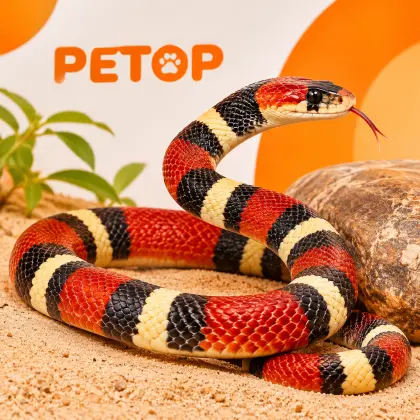
Milk snake
Mimics the coral snake but is harmless.
Behavior traits
Scores from 1 to 5 reflect breed averages; every animal has its own personality.
The milk snake or milksnake, is a species of kingsnake; there were once up to 24 subspecies recognized, however fewer are officially recognized today. Lampropeltis elapsoides, the scarlet kingsnake, was formerly classified as a 25th subspecies, but is now recognized as a distinct species. The previously delineated subspecies have strikingly different appearances, and many of them have their own common names. Morphological and genetic data suggest that this species could be split into several separate species, and it has been by several authorities. Lampropeltis gentilis, Lampropeltis annulata, Lampropeltis abnorma, Lampropeltis polyzona, and Lampropeltis micropholis have been elevated to the species level. Milksnakes are not venomous.
General care guide: Reptiles
Heat and light
Reptiles rely on their environment for body heat. Provide a thermal gradient with a thermostat and proper UVB lighting.
Diet & law
Insects dusted with calcium for geckos and dragons, greens for tortoises and iguanas, frozen-thawed rodents for snakes. Native Iranian reptiles are protected—only captive-bred, non-venomous species may be listed.
Frequently asked questions
How long does a Milk snake live?
A Milk snake typically lives about 15-20 years, and good nutrition and regular checkups can extend that.
Is a Milk snake good for apartments?
Yes — with enough daily activity, a Milk snake adapts well to apartment life.
Is a Milk snake good with children?
Yes — a Milk snake is usually gentle and patient with kids, though play should always be supervised.