
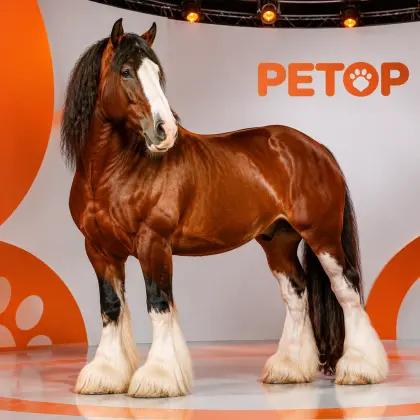
Clydesdale horse
A giant draft horse with white feathered legs.
Behavior traits
Scores from 1 to 5 reflect breed averages; every animal has its own personality.
The Clydesdale is a breed of draught horse which originated in the seventeenth century, and takes its name from the Clydesdale district of Scotland. The first recorded use of the name "Clydesdale" for the breed was in 1826; the horses spread through much of Scotland and into northern England. After the breed society was formed in 1877, thousands of Clydesdales were exported to other countries, particularly to Australia and New Zealand. In the early twentieth century numbers began to fall, both because many were taken for use in the First World War, and because of the increasing mechanisation of agriculture. By the 1970s, the Rare Breeds Survival Trust considered the breed vulnerable to extinction. Numbers have since increased slightly.
General care guide: Farm animals
Livestock & poultry
Buy from licensed farms with health codes, check vaccination records and quarantine newcomers for 2–3 weeks.
Prevention
Follow regional vaccination schedules (FMD, enterotoxaemia, PPR, Newcastle). Horses need quality forage, farriery every 6–8 weeks and yearly dental care.
Frequently asked questions
How long does a Clydesdale horse live?
A Clydesdale horse typically lives about 20-25 years, and good nutrition and regular checkups can extend that.
Is a Clydesdale horse good for apartments?
A Clydesdale horse needs more space and lots of exercise; a small apartment isn’t ideal.
Is a Clydesdale horse good with children?
Yes — a Clydesdale horse is usually gentle and patient with kids, though play should always be supervised.